The physical problem
Optimized structures are commonly interpreted as one continuous material. Real systems contain joints and interfaces that may open, remain compressed or transmit shear.
MSc candidate · Interfaces in topology optimization
Can an optimizer decide where materials should connect, separate or transfer traction?
Jenário develops finite-element topology optimization methods that identify and evaluate interfaces as they emerge during design.
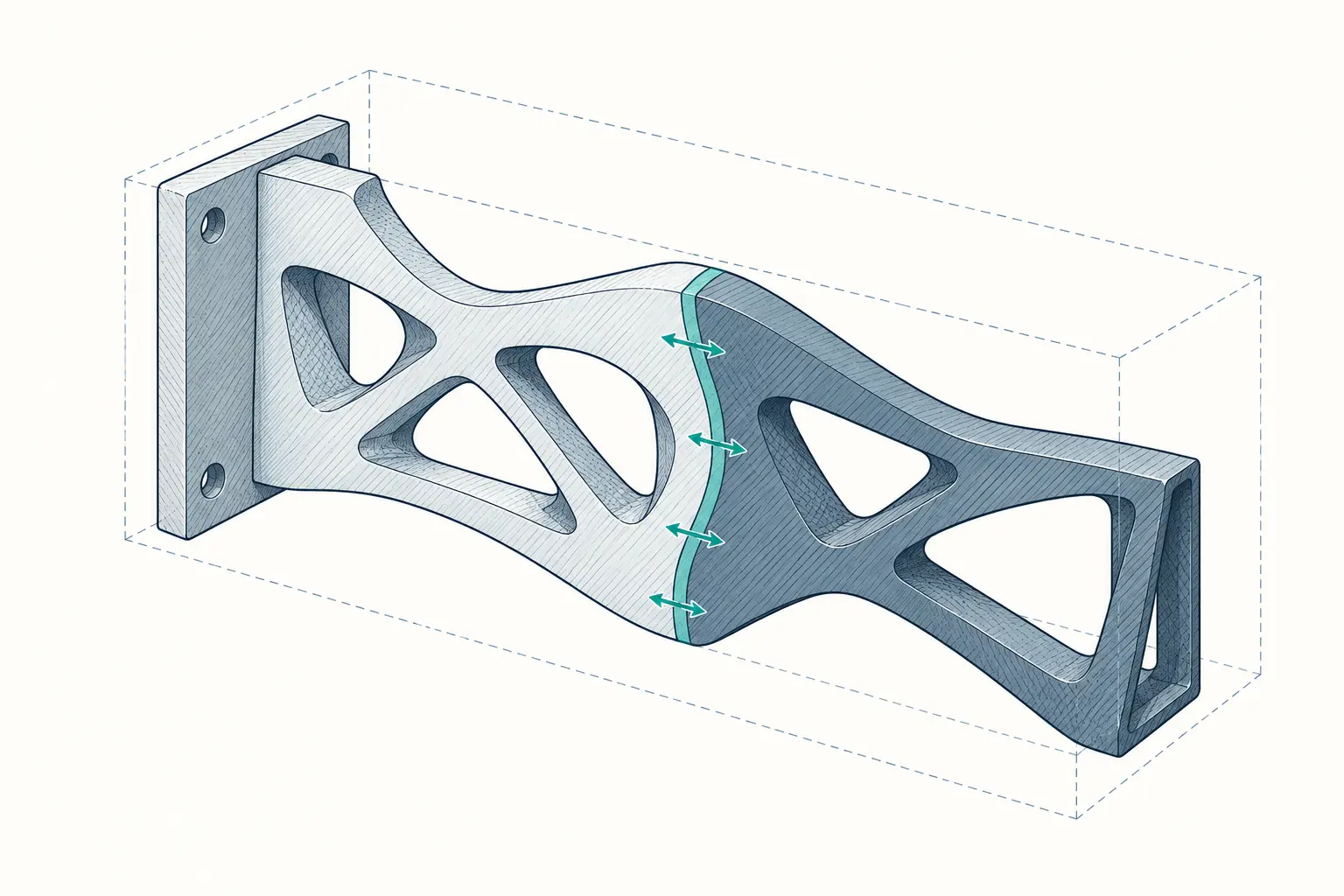
Optimized structures are commonly interpreted as one continuous material. Real systems contain joints and interfaces that may open, remain compressed or transmit shear.
His current research identifies candidate interfaces inside evolving topologies, formulates admissibility conditions and recovers tractions along the final boundaries. Earlier work examined how buried foundations alter the performance of vibration barriers.
Treating interfaces explicitly can turn mathematically optimal shapes into designs whose assembly and mechanical behaviour are physically meaningful.
Research evidence
Explore published studies, conference contributions and ongoing investigations.
Conference paper
Embedding a wall changes more than its effective height. The buried portion changes how surface waves scatter into bulk waves, which can reshape the attenuation spectrum.
DINAME proceedingsWork in progress
The current formulation is being developed to identify candidate interfaces and evaluate whether they remain compressed, open or transmit traction as the topology evolves.