
The physical problem
A dynamically optimized structure is often designed on a perfectly rigid base. Real soil deforms and carries energy away as waves, changing resonances, force paths and the amount of vibration that can be reduced.
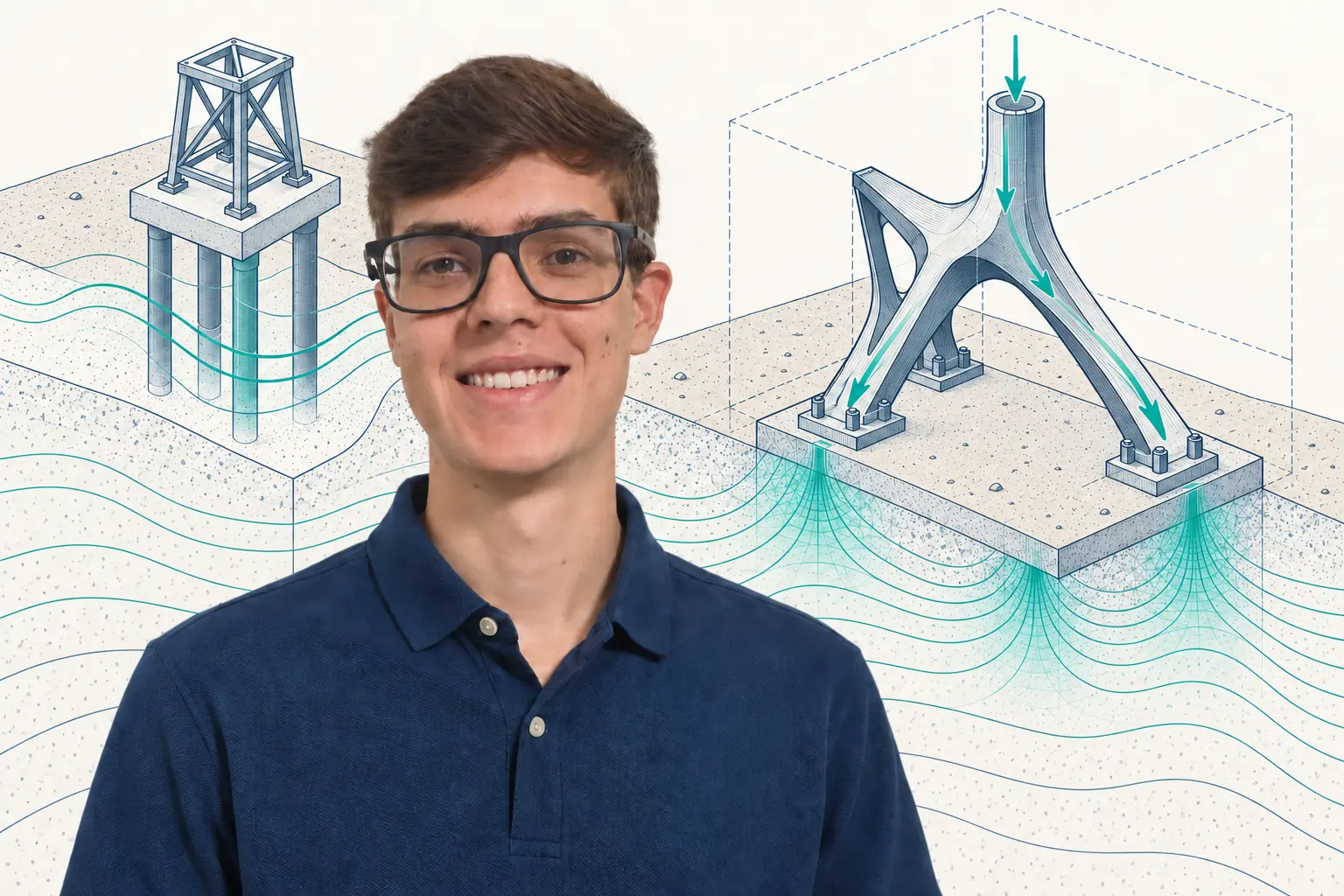
MSc candidate · Dynamic topology optimization with SSI
How does flexible, radiating soil change the structure an optimizer chooses?
Lucas develops topology optimization methods for harmonically excited structures coupled to an unbounded soil.
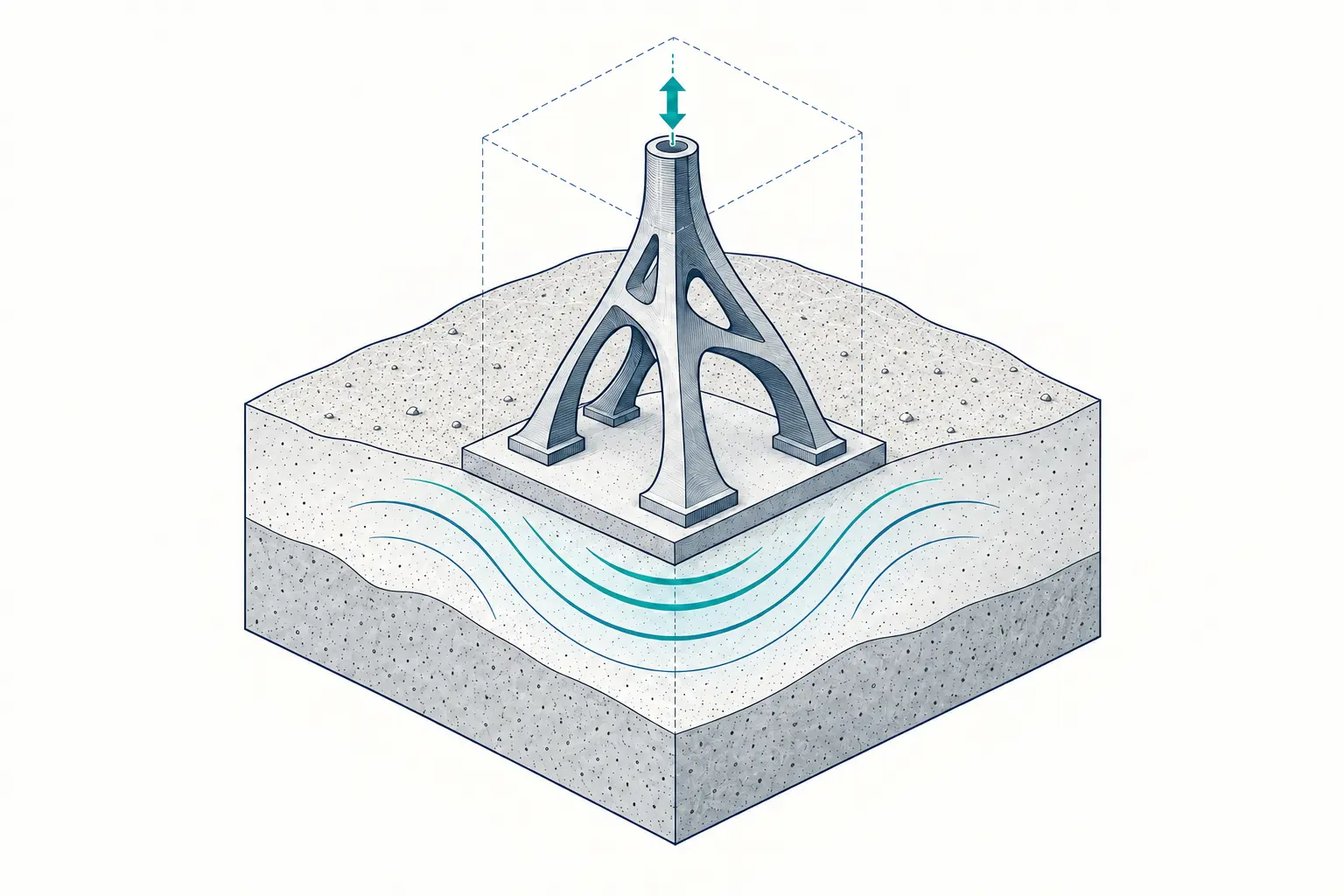
A dynamically optimized structure is often designed on a perfectly rigid base. Real soil deforms and carries energy away as waves, changing resonances, force paths and the amount of vibration that can be reduced.
His work began with a scalable three-dimensional implementation of TOBS and then extended sequential integer linear programming to time-harmonic loading. His MSc couples a finite-element superstructure to an IBEM representation of the unbounded soil.
For vibration-sensitive facilities, the best structural topology may depend on the foundation and surrounding ground. A fixed-base optimizer can therefore choose the wrong load path.
Research evidence
Explore published studies, conference contributions and ongoing investigations.
Conference paper
The binary optimization scheme handled large 3D design domains and produced stable optimized tower and beam forms without relying on intermediate-density material.
Full ABCM paperConference paper
The next formulation carried the integer-programming approach into harmonic dynamics, establishing the fixed-base benchmark needed before soil flexibility is introduced.